The moment the name Ravana is mentioned, the image that usually appears in our minds is that of a tyrant, a demon, and a symbol of adharma. But Sanatan tradition does not judge a personality only by its end — it also looks at knowledge, tapasya, devotion, and inner qualities.
If seen with neutrality, Ravana was not merely a powerful king of Lanka — he was:
- A supreme devotee of Lord Shiva
- A master of the Vedas and scriptures
- A great scholar, musician, and astrologer
- An extraordinary spiritual practitioner
His life is not just a story of downfall — it is a deep spiritual lesson about the thin line between devotion and ego.
The Peak of Ravana’s Shiva Bhakti
Pandit Pradeep Mishra Ji often says:
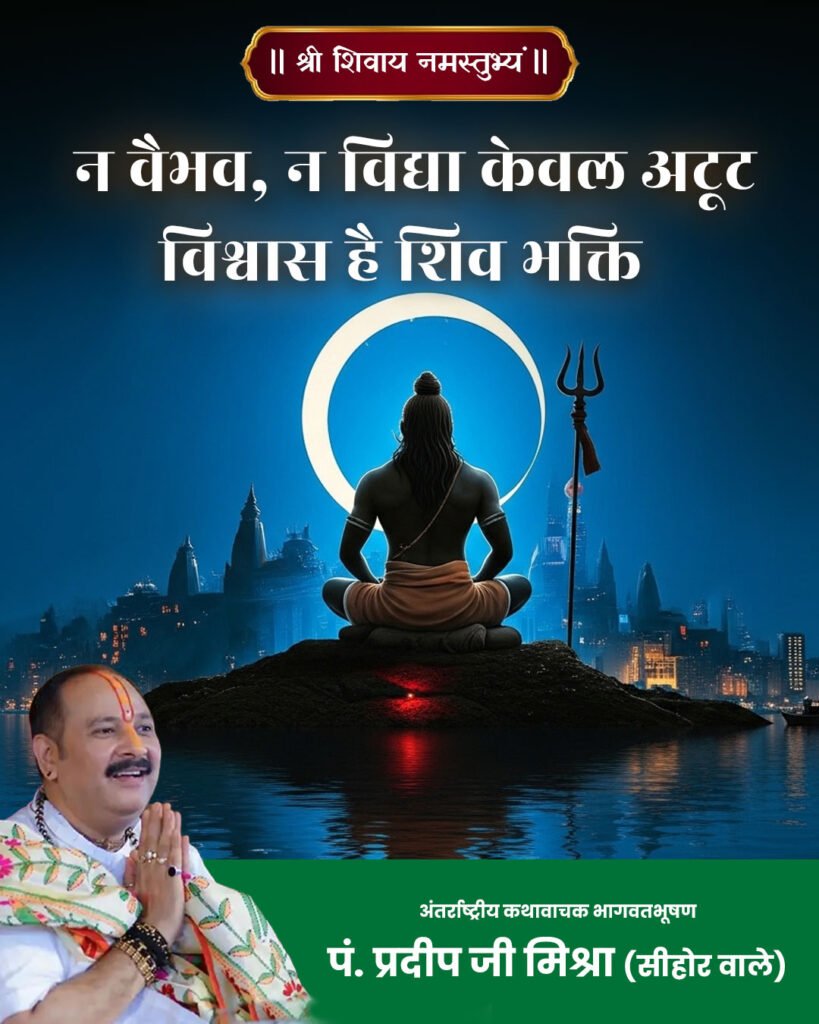
“Lord Shiva is hungry for emotion, not for the identity of the devotee.”
This perfectly reflects Ravana’s devotion.
It is believed that Ravana performed intense penance for years to please Mahadev. The famous incident of lifting Mount Kailash was not merely a display of power — it was an expression of his intense longing for Shiva.
When Shiva pressed the mountain with His toe, Ravana’s pride was crushed, and in that moment of surrender he sang the Shiva Tandava Stotram, one of the most powerful hymns ever composed.
Pleased with his devotion, Lord Shiva granted him:
- The divine sword Chandrahāsa
- The honor of being recognized as a great devotee
Ravana: The Master of Knowledge and Sacred Sciences
Ravana was not just strong — he was one of the greatest scholars of his time. He had deep knowledge of:
- The Vedas and Upanishads
- Jyotish (astrology)
- Ayurveda
- Music and classical arts
The Shiva Tandava Stotram, which even today energizes Shiva devotees in their sadhana, stands as a living proof of his devotion, poetic brilliance, and spiritual depth.
The Core Teaching: When Knowledge Meets Ego
Pandit Pradeep Mishra Ji explains:
“Knowledge connected to devotion leads to liberation,
but knowledge connected to ego leads to destruction.”
This was the turning point in Ravana’s life.
Ravana’s Greatest Mistake
Ravana’s devotion was powerful, but his ego overshadowed his wisdom.
He forgot that the path of Shiva is:
- Compassion
- Restraint
- Dharma
- Respect for others
The abduction of Mata Sita was not just a political act — it was the result of ego, desire, and the misuse of power.
And that single act:
- Covered his tapasya
- Destroyed his glory
- Led to his downfall
Pandit Ji says:
“When ego enters devotion, devotion itself becomes a bondage.”
Life Lessons from Ravana
Ravana is a deeply layered personality who teaches timeless truths:
- Ego blinds even the most learned person
- Knowledge without character is dangerous
- Desire and greed lead to destruction
- Power without dharma cannot survive
- Repentance at the end cannot rewrite a life
- Devotion must be accompanied by humility
- Self-control is greater than scholarship
- True Shiva Bhakti respects the rights and dignity of others
A Warning and an Inspiration
Ravana is not just a villain — he is also a spiritual warning.
He teaches us:
Even after receiving divine grace,
if ego remains — downfall is certain.
Pandit Pradeep Mishra Ji says:
“Greater than becoming a devotee of Shiva is becoming like Shiva.”
If Ravana had adopted Shiva’s qualities:
- Detachment
- Compassion
- Humility
- Dharma
his history would have been completely different.
The Spiritual Conclusion
Ravana’s life presents two parallel truths:
As a Devotee:
- His tapasya was unmatched
- His knowledge was vast
- His devotion was intense
As a King:
- His ego became his enemy
- His desires led to his destruction
This is why his story is eternally relevant.
It tells us:
Devotion gives power —
humility makes it divine.
Final Message
To walk the path of Shiva:
- Devotion is not enough
- Knowledge is not enough
- Power is not enough
What is required is:
Bhakti + Vinamrata + Maryada
Only then does a seeker avoid the fate of Ravana and move toward the state of Shiva.