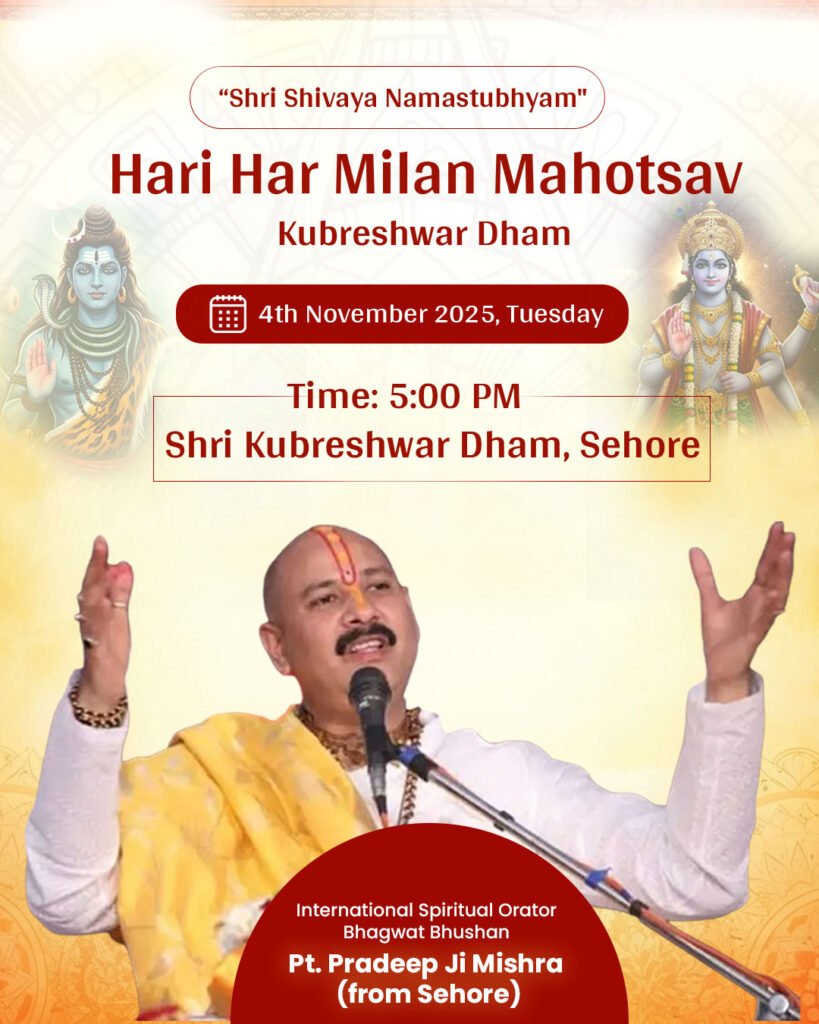
All the stories and episodes in our ancient scriptures are neither meaningless nor ordinary. Each one carries deep symbolic messages, conveyed through metaphors and coded expressions — much like the language of computers. To the uninitiated, these stories may appear simple or even strange, but those with wisdom decode their hidden meanings and present them in ways that guide and enlighten society. The episode of Hari–Har Milan — the union of Lord Vishnu (Hari) and Lord Shiva (Har) — is one such profound narrative. Though it may appear to be a simple mythological tale, it holds immense spiritual, social, and environmental significance. It can be seen as a confluence of spirituality, social harmony, and ecological awareness.
Mythological Significance of the Episode
According to the Puranas, when Lord Vishnu in his Vamana avatar asked King Bali for three paces of land, he measured the earth with one step and the heavens with the second. For the third, King Bali humbly offered his head. After this act, Lord Vishnu sent him to the underworld (Patal) but blessed him with the boon of guarding his realm for four months. During this period — from Devshayani Ekadashi to Devotthana Ekadashi — Lord Vishnu rests, and Lord Shiva oversees the functioning of the universe. On Vaikuntha Chaturdashi, Lord Shiva hands back the responsibility of cosmic governance to Lord Vishnu before departing to the Himalayas for penance. Thus, this day marks the divine meeting of Hari and Har, described in the Skanda Purana, Padma Purana, Vishnu Purana, and Bhagavata Purana.
Another related legend comes from Baidyanath Dham in Deoghar, Bihar. It is said that Ravana was carrying a Shivling to Lanka when he had to stop to relieve himself. He entrusted the Shivling to a young boy — none other than Lord Krishna in disguise. The boy placed the Shivling on the ground, and Ravana could not lift it again. Since that day, the union of Hari (Krishna/Vishnu) and Har (Shiva) has been celebrated as Hari–Har Milan. In Ujjain, Madhya Pradesh, this divine meeting is observed every year at the Mahakaleshwar Temple, where Lord Mahakal is brought before Lord Gopal of the Gopal Mandir. During the ritual, Lord Shiva is adorned with tulsi garlands from Lord Vishnu, while Lord Vishnu is offered bilva leaves — symbolizing the unity and mutual reverence between the two deities.
Hari and Har — Two Forms of One Supreme Consciousness
According to Sanatan Dharma, Shiva and Vishnu are not distinct; they are two aspects of the same Supreme Being (Parabrahman). Lord Vishnu considers Shiva as his revered deity, while Shiva holds Vishnu within his heart. Tulsidas beautifully captures this in the Ramcharitmanas, where Lord Rama declares:
“Shiv samaan mohi priya nahi koi.”
Similarly, Shiva addresses Lord Rama as Sachchidananda — the embodiment of truth, consciousness, and bliss.
Whenever Lord Vishnu incarnates on earth, Shiva appears in various forms to witness his divine play. Before the battle of Lanka, Lord Rama installed the Shivling at Rameshwaram — a gesture acknowledging the unity of their energies. Tulsidas further emphasizes:
“Shankar bhajan binu nar bhagati na paavai mori” — without devotion to Lord Shiva, one cannot attain devotion to me.
Thus, both are inseparable — one represents the body (Shiva as the element of nature), the other the soul (Vishnu as the sustaining principle). Together, they complete the cycle of creation and existence.
A beautiful example of this unity is found in the story of Vitthal (Vithoba) of Pandharpur, Maharashtra. A devotee once promised to offer a golden waistband to Lord Vitthal if blessed with a child. When the child was born, he approached a goldsmith named Narhari, a staunch devotee of Lord Shiva, to craft the ornament. Narhari initially refused, saying he could not work for Vishnu. However, divine intervention led him to the temple blindfolded. As he measured the Lord’s waist, he felt tiger skin beneath his hands — a symbol of Shiva. Curious, he peeked beneath the blindfold and saw alternating visions of Vishnu and Shiva. Overwhelmed with realization, Narhari wept and sought forgiveness, recognizing that Hari and Har are one. Even today, Lord Vitthal’s idol bears a Shivalinga on his crown, symbolizing this eternal unity.
During the Hari–Har Milan celebrations in Ujjain, Lord Mahakal is adorned like Lord Gopal, and Lord Gopal is dressed like Lord Shiva — reaffirming the message of harmony and divine oneness.
A Symbol of Social Unity
The Hari–Har Milan represents more than spiritual union — it stands as a symbol of social harmony and integration. In the 16th century, tensions arose between the Vaishnav (followers of Vishnu) and Shaiva (followers of Shiva) sects. The Hari–Har Milan narratives bridged this divide, restoring balance and mutual respect between the two paths.
Philosophically, Lord Shiva represents Prakriti (nature) — the five elements: space, air, fire, water, and earth — while Lord Vishnu embodies Atma-tattva (the sustaining life force). Together, they constitute the wholeness of creation. Without one, the other cannot exist. Thus, their union symbolizes the eternal truth that balance and coexistence sustain the universe.
Let us, therefore, draw inspiration from the Hari–Har Milan and integrate its message of unity, balance, and peace into our lives — fostering harmony within ourselves, our communities, and with the divine.
BOX: Simple Efforts for Peace and Prosperity
In today’s times, when people are burdened with stress and struggles, even small acts of faith and discipline can invite divine grace. The Hari–Har Milan on Vaikuntha Chaturdashi offers such an opportunity for spiritual upliftment and relief from life’s troubles.
Remedy 1
If you are facing prolonged difficulties, on Vaikuntha Chaturdashi take a lotus flower, a bit of turmeric, and white sandalwood. Offer them to Lord Shiva while chanting “Shri Shivaya Namastubhyam.” Mix turmeric in water and pour it over the Shiva Lingam, then offer the lotus and sandal paste while expressing your wish. This ritual is believed to resolve obstacles and fulfill desires.
Remedy 2
Between 11:30 p.m. and 4:00 a.m. on Vaikuntha Chaturdashi, place idols of Lord Shiva and Lord Vishnu (or Laddu Gopal) together in your home temple. Offer tulsi to Vishnu and bilva leaves to Shiva, then reverse the offering — tulsi to Shiva and bilva to Vishnu. Store these leaves in honey and give the honey daily to any family member struggling with negativity or poor mental health. It is said to bring calmness and positive transformation.
Remedy 3
Light 14 ghee lamps before both deities after 11:30 p.m. on Vaikuntha Chaturdashi. Place one near the tulsi plant, another near your household water source, and the remaining 12 in various corners of your home. This is believed to remove obstacles, bring prosperity, and fulfill heartfelt desires.